
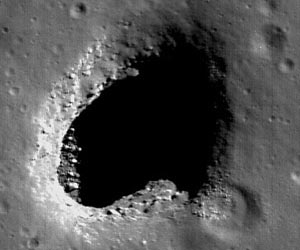
The cavernous splotches that help give our moon its shape could be much more than a product of celestial aging. According to research conducted by roboticist Red Whittaker at Carnegie Mellon University, they could also serve as firsthand insight into our search for life on Mars.
Spates of lunar skylights are now being discovered with increased clarity thanks to the advancement of photographic technology. Skylights, which are born when the ceiling of lunar cave gives out under its own weight, allow expanded access to subterranean layers of the moon which previously seemed unattainable.
While these skylights have become easier to find, our image-casting technology falls short when it comes to their actual exploration. Although NASA's high-res Lunar Reconnaissance Orbiter birls around the moon at a mere 50km and harbors one of our most sophisticated modeling systems, it struggles to process areas of the moon that loom in deeper, darker depressions. Unfortunately, skylights fall into that category.
The answer, according to Red and his team, is to take a two-part approach to inspection: aerial and surface. By syncing a flyover camera with a rover-mounted device, scientists are given the ability to model the moon's geography with increased precision.
Once a bird's-eye view has been captured, it can be used to instruct the path of a ground-mapping rover, which yields a higher quality model than using a land-based or airborne approach alone.
At Carnegie Mellon, researchers are putting the tandem to the test with encouraging results. While no actual space mission has been launched, reports show a 92% accuracy rate in simulated experiments, which is notably higher than the methods currently employed on the moon.
Additionally, the experimenters have witnessed significant path-length reduction for rovers. A shorter path means a faster, more efficient process with less lag time before data collection.
Of course, exploring these skylights is more than just an academic endeavor. Planetary caves could potentially offer protection from radiation and other hazards, and it's long been suspected that remnants of ancient life could be speckled under the surface of Mars.
Excavation and retrieval on the red planet is still a few years away; Mars is that much farther, that much colder, and that much more mysterious than our moon. But the first steps in combing through Martian bunkers are contingent on a thorough, successful test run on a lunar skylight. Not to mention, the technology required to dissect these skylights could help us right on our own turf, too.
According to Texas Electricity Providers, unveiling our moon's shadowy regions could lead to the capture and utilization of helium-3, a highly efficient resource for renewable energy.
With more and more research being poured into the field, it shouldn't be long before Dr. Whittaker is mapping the groundwork of our closest cosmic neighbors. And after that? Well, who's to say? I hear Jupiter is nice this time of year.
