
The Democratic Republic of Congo (DRC) on Tuesday declared the end of a 25-month outbreak of measles that claimed the lives of more than 7,000 children aged under five.
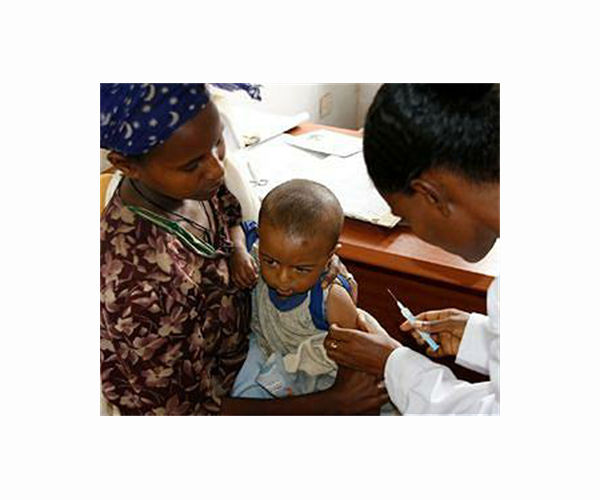
The outbreak was countered by vaccination on a massive scale, in which millions of children and infants were immunised.
"For the past month, we are able to say that this epidemic has been eliminated from across our territory," Health Minister Eteni Longondo told a press conference.
"We can say that measles (in the DRC) no longer exists."
Measles is a highly contagious viral disease that attacks mainly children. The most serious complications include blindness, brain swelling, diarrhoea, and severe respiratory infections.
Once common, the disease has been rolled back around the world thanks to a cheap and effective vaccine, but low rates of immunisation among a community can cause infection to spread quickly.
"The measles epidemic was unfolding at low level but was the deadliest. It carried off more than 7,000 of our children," Longondo said.
Routine vaccinations will continue in order to prevent the virus from bouncing back, he added.
The first cases of measles in the latest outbreak were recorded in June 2018. As of January this year, the WHO had recorded more than 335,000 suspected cases of the disease, of which 6,362 were fatal.
By way of comparison, the DRC — a vast country the size of continental western Europe — has recorded 9,891 cases of coronavirus, of which 251 were fatal.
An outbreak of Ebola in the east of the country, which was declared over on June 25 after nearly two years, killed 2,287 people.
The announcement in Kinshasa came ahead of an expected declaration Tuesday by the UN's World Health Organization (WHO) that wild poliovirus has been eradicated from Africa.
Health teams have been fighting to wipe out polio's last vestiges on the continent, in northeastern Nigeria, where jihadists said vaccination was a conspiracy to sterilise young Muslims.
Spain calls in army to fight virus pandemic
Madrid (AFP) Aug 25, 2020 –
Spain will call in the army to help identify those who have been exposed to people infected with coronavirus as part of efforts to curb the spread of the disease, Prime Minister Pedro Sanchez said Tuesday.
The central government will make 2,000 soldiers who are trained in tracking available to the regions, which are responsible for health care, to assist in tracking cases and stem a rise in infections, he told a news conference.
"We could even increase this figure as required through the urgent training which we have planned," Sanchez said.
Many experts have blamed a lack of virus trackers for a surge in COVID-19 infections in several Spanish regions such as Madrid and Catalonia.
Sanchez urged Spaniards to use a smartphone app designed by the government called RadarCovid which can identify people who have crossed paths with a contagious patient and alert them so they can get tested or be quarantined.
He also announced that regional authorities could ask the central government to apply a state of emergency, which would allow it to limit people's movements, on part or all of its territory.
The central government declared a nationwide state of emergency in mid-March which allowed it to impose one of the world's strictest lockdowns, with people allowed outside only to buy food or medicine, seek medical care, briefly walk their dog or go to work if it was impossible to do their jobs from home. It was only fully lifted on June 21.
While the rise in infections in Spain is "worrying", it is "far from the situation in mid-March", Sanchez said.
"We can't let the pandemic to once again take control of our lives… we must take control and halt this second curve."
Infections have risen sharply since Spain lifted the lockdown, but deaths have been much lower than during the epidemic's peak.
The country has more than 400,000 confirmed cases of the respiratory disease, the highest in western Europe, and one of the fastest growth rates on the continent.
Nearly 29,000 people have died, one of the world's highest tolls.
