
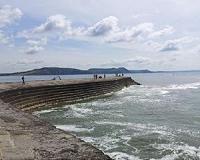
As we expand our coastal cities and armor the coast against the ravages of the sea, we lose the resiliency of the coastlines' natural defenses. Rachel Gittman and colleagues at the University of North Carolina, NOAA, and the US Coast Guard report in the August issue of ESA Frontiers that sea walls, bulkheads, breakwaters, and the like put in place to protect coastal communities harden 14 percent (22,842 km) of the tidal shoreline of the United States. But this conservative 14 percent hides a concentration of coastal development along soft marshy estuaries, lagoons, and tidal rivers; remote rocky coasts are less likely to be bolstered with artificial structures.
+ Gittman and coauthors Danielle Keller and Joel Fodrie will present research related to this report on shoreline habitat, hardening, and the ecosystem services trade-offs of different shoreline conditions at the upcoming 100th Annual Meeting of the Ecological Society of America in Baltimore, Md. on August 9-14.
+ Rachel K. Gittman, OOS 77-5 The living shoreline approach as an alternative to shoreline hardening: Implications for the ecology and ecosystem service delivery of salt marshes. Thursday, August 13, 2015: 2:50 PM, room 329, Baltimore Convention Center
+ Danielle A. Keller, COS 7-9 Landscape setting affects the structure and function of oyster reefs. Monday, August 10, 2015: 4:20 PM, room 321, Baltimore Convention Center
+ F. Joel Fodrie. COS 7-7 Landscape context effects the ecosystem-service delivery of temperate biogenic reefs. Monday, August 10, 2015: 3:40 PM, room 321, Baltimore Convention Center
The ecological vibrancy of wetland habitats is valued by birders, hunters, recreational anglers, and commercial fisheries managers. Coastal wetlands succor birds, fish, and crustaceans, filter outflowing pollution, and naturally buffer the coast against storm surge and erosion. But natural dunes and salt marshes also absorb the energy of storms. Examples of natural dunes and salt marshes emerging from severe storms with little to no damage, while nearby bulkheads took a battering, suggest that storm surge protection and habitat protection need not be at odds.
Nearly a third of the shoreline in the contiguous United States could be hardened by the end of the twenty-first century if the rate of shoreline hardening observed over the last century continues. On sheltered coasts, fortification of shorelines correlates more strongly with high housing density and GDP than with wave height or frequent storms.
The authors project that growing populations will direct most new hardening to the US' south Atlantic and Gulf coasts, which encompass greater that 50 percent of the remaining salt marshes and 100 percent of the mangrove forests in the US. The authors argue for the incorporation of green infrastructure into coastal protections as managers plan for the next century of growing cities and rising sea levels.
Engineering away our natural defenses: an analysis of shoreline hardening in the US (2015) Rachel K Gittman, F Joel Fodrie, Alyssa M Popowich, Danielle A Keller, John F Bruno, Carolyn A Currin, Charles H Peterson, and Michael F Piehler. Frontiers in Ecology and the Environment, 13:6, 301-307.
